



In 1968, the world was shaking. The Vietnam War was tearing societies apart, political assassinations were reshaping nations, and student uprisings were rattling governments from Paris to Tokyo. Closer to home, New Zealanders were reeling from the Wahine disaster, still processing the shock of 53 lives lost in Wellington Harbour in April, and barely a month later a 7.1 magnitude earthquake struck Inangahua. It was a year that left marks.
And yet, in boatyards the length of the country, craftsmen were quietly getting on with the work of building something that would last.
In 1968, New Zealand’s boat-building industry was mid-transformation. Fibreglass technology was beginning to reshape the market, challenging the kauri and timber traditions that had defined the trade for generations. But the transition was far from complete. Some of the finest timber vessels ever launched in this country were still taking shape on the hardstand, built by names that still resonate: Owen Woolley, John Lidgard, Roger Carey, Frank Visser, Jim Young.
The era had swagger, too. At Lake Ruataniwha, the hydroplane Bel Air III set a world record of 177.36mph, powered by a Ford V6. At Lake Rotoiti in April, Flak-Too smashed through the 100mph barrier. Mini boat racing arrived in Whangarei and spread rapidly across the country. Yamaha chose New Zealand as the testing ground for its new 8hp and 25hp outboard motors. Kiwi builders and sailors were making noise well beyond their own waters.
What’s remarkable, more than half a century on, is what has survived.
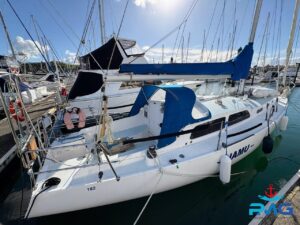
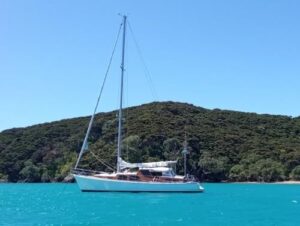
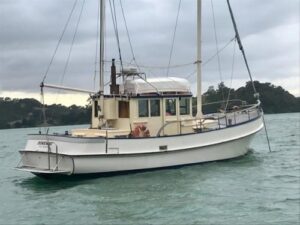
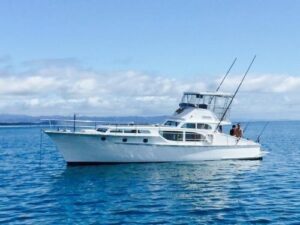
Six boats built in 1968 are currently listed for sale through TradeABoat, and collectively they read as a portrait of an era. There’s the Owen Woolley sedan, a 12-metre kauri-planked displacement cruiser with four-berth accommodation, now in Tauranga at $58,000. There’s the John Lidgard motorsailer, Nomad V, a triple-skin kauri 43-footer out of Opua with a berth lease running to 2049, offered at $95,000 boat only. Roger Carey’s 39ft trawler-style Hinewai, powering out of Auckland at $160,000, is as purposeful today as the day she was launched. A Parsons displacement launch in Tauranga, strip-planked and glassed, twin Ford diesels, game rigged and ready, asks $55,000. Frank Visser’s Kingfisher in Picton, a carvel-planked motor-sailer with solar, Victron charging and a new Ford six, is listed at $79,000. And then there is Namu, the Jim Young 37 with a racing pedigree that is the stuff of legend at the Royal New Zealand Yacht Squadron, now thoughtfully converted for cruising and offered at $29,000.
These are not museum pieces. Every one of them has been maintained, updated, and lived aboard. Kauri hulls that passed survey in 2024. New electronics. Rebuilt winches. Replaced engines. The bones are 1968; the fit-out reflects decades of owners who refused to let them go.
That says something, not just about the quality of the original build, but about what these boats represent. In a year when New Zealand was absorbing real trauma, when the Wahine had just gone down and the ground was still moving after Inangahua, craftsmen in yards across the country were laying kauri and driving fastenings and building things they believed would outlast them. They were right.
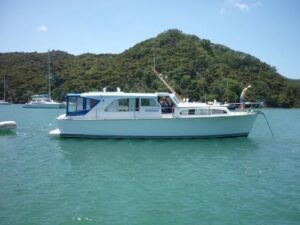
Otis Redding recorded “Dock of the Bay” not long before he died in late 1967, and the song topped the charts through 1968. There’s something fitting about that, a meditation on sitting still, watching the tide, finding peace on the water. The boats these builders launched that year have been doing just that, riding tides and watching harbours, for 57 years.
Some of them are still looking for their next owner.