


Lhyfe, a producer of green and renewable hydrogen, has inaugurated its offshore renewable green hydrogen production demonstrator in Saint-Nazaire, France.
It is the first time in the world that renewable hydrogen will be produced at sea.
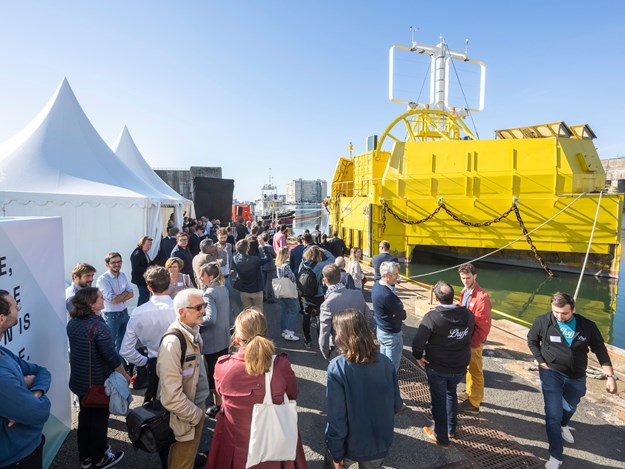
The “Sealhyfe” platform, which seeks to pave the way for a new energy paradigm, is starting an 18-month experimental period, at quay then off the coast of Le Croisic, on the offshore testing site operated by French engineering school Centrale Nantes.
Producing hydrogen at sea: A global challenge to be tackled
Around the world, the race for hydrogen is on and the development of offshore wind farms is booming. Lhyfe – which inaugurated the world’s first site for the production of hydrogen from onshore wind turbines in September 2021 and which is currently preparing to deploy its solutions Europe-wide – is convinced of the central role offshore has to play in the massification of renewable green hydrogen production.
The company says producing hydrogen using offshore wind turbines could allow all countries with a coastline to access renewable green hydrogen, produced locally, beyond the horizon line, and in industrial quantities, to decarbonise transportation and industry.
Through this pilot site, Lhyfe will produce the first kilograms of renewable green hydrogen at quay and then at sea, operating automatically, in the most extreme conditions. The company has set the bar high by installing its production unit on a floating platform, connected to a floating wind turbine.
The Sealhyfe platform must therefore meet several major and unprecedented challenges, including:
- Performing all stages of hydrogen production at sea, i.e. converting the electrical voltage from the floating wind turbine, pumping, desalinating and purifying seawater, and breaking the water molecules via electrolysis to obtain renewable green hydrogen;
- Managing the effects on the system of the platform’s motion: list, accelerations, swinging movements, etc.;
- Enduring environmental stress: Sealhyfe will have to survive the premature ageing of its parts (corrosion, impacts, temperature variations, etc.);
- Operating in an isolated environment: the platform must operate fully automatically, without the physical intervention of an operator, except for scheduled maintenance periods which have been optimally integrated from the design phase.
To achieve this technological feat, Lhyfe relied on the facilities of the offshore testing site, SEM-REV, operated by Centrale Nantes.
The production unit was installed on the WAVEGEM wave energy platform developed by Geps Techno.
At the end of the quayside test phase, the Sealhyfe platform will integrate the SEM-REV offshore testing area, off the coast of Le Croisic, about 20 kilometres from the coast. The device will then be supplied with electricity by the pioneering floating wind turbine installed within the offshore test site in 2018.
A multi-phase trial
A first six-month trial phase is being started at quay, in the port of Saint-Nazaire, to obtain initial reference measurements and test all of the systems (desalination and cooling systems, stack behaviour, remote control, energy management, resistance to environmental conditions, etc.).
At the end of this first stage, Sealhyfe will spend a period of 12 months off the Atlantic coast. It will be installed less than a kilometre from the floating wind turbine, fixed to the ground by a system of anchors and connected to the site’s underwater hub using an umbilical designed and dedicated for this application.
At the end of this trial, Lhyfe will have a substantial volume of data, which should allow it to design mature offshore production systems, and to deploy robust and proven technologies on a large scale, in keeping with the EU’s objective to produce 10 million tonnes a year of renewable hydrogen by 2030.
Sealhyfe has the capacity to produce up to 400kg of renewable green hydrogen a day, equivalent to 1MW of power.
By 2030-2035, offshore could represent an additional installed capacity of around 3 GW for Lhyfe.
“At Lhyfe, we have only one aim: to leave a more breathable planet for our children. This is why we once again wanted to take up a major technological challenge, to prove – by producing hydrogen at sea for the first time – that it is possible to do it as of today,” says Matthieu Guesné, chairman and CEO and founder of Lhyfe.
“By paving the way for the mass production of renewable hydrogen at sea, Sealhyfe is fully in line with the EU’s strategy to deploy an offshore hydrogen chain, and wishes to help build the energy sovereignty of countries.”
Photography: Lhyfe